
How to Soften a Stiff Leather Jacket: What Works and What Wrecks It

A stiff leather jacket is three completely different problems wearing the same symptom, and almost every article online treats it as one. That is why so much of the advice contradicts itself, and why people end up with a jacket that is worse than when they started.
A brand-new horsehide jacket that will not bend at the elbow does not need what a forty-year-old jacket that has dried out in a closet needs. Neither needs what a jacket that got soaked and dried badly needs. Work out which one you have first, and the right answer follows.
The short version
- New and stiff means the leather is firm, not damaged. Wearing it is the fix. Conditioner will not speed it up.
- Dried out means the oils have gone. Thin coats, spread over months, will help, though damage already done cannot be fully undone.
- Water damaged means dry it correctly first, then condition. Patchy stiffness and tide lines are the tell.
- Wearing a jacket is mechanically the same process a tannery uses to soften leather. It is not a slower substitute for conditioner. It is a different mechanism that conditioner cannot replicate.
- A dime-sized amount of lotion is the dose for an entire jacket.
- Heat is not a shortcut. Wet leather shrinks at temperatures a tumble dryer reaches easily.
Which of the three do you have?
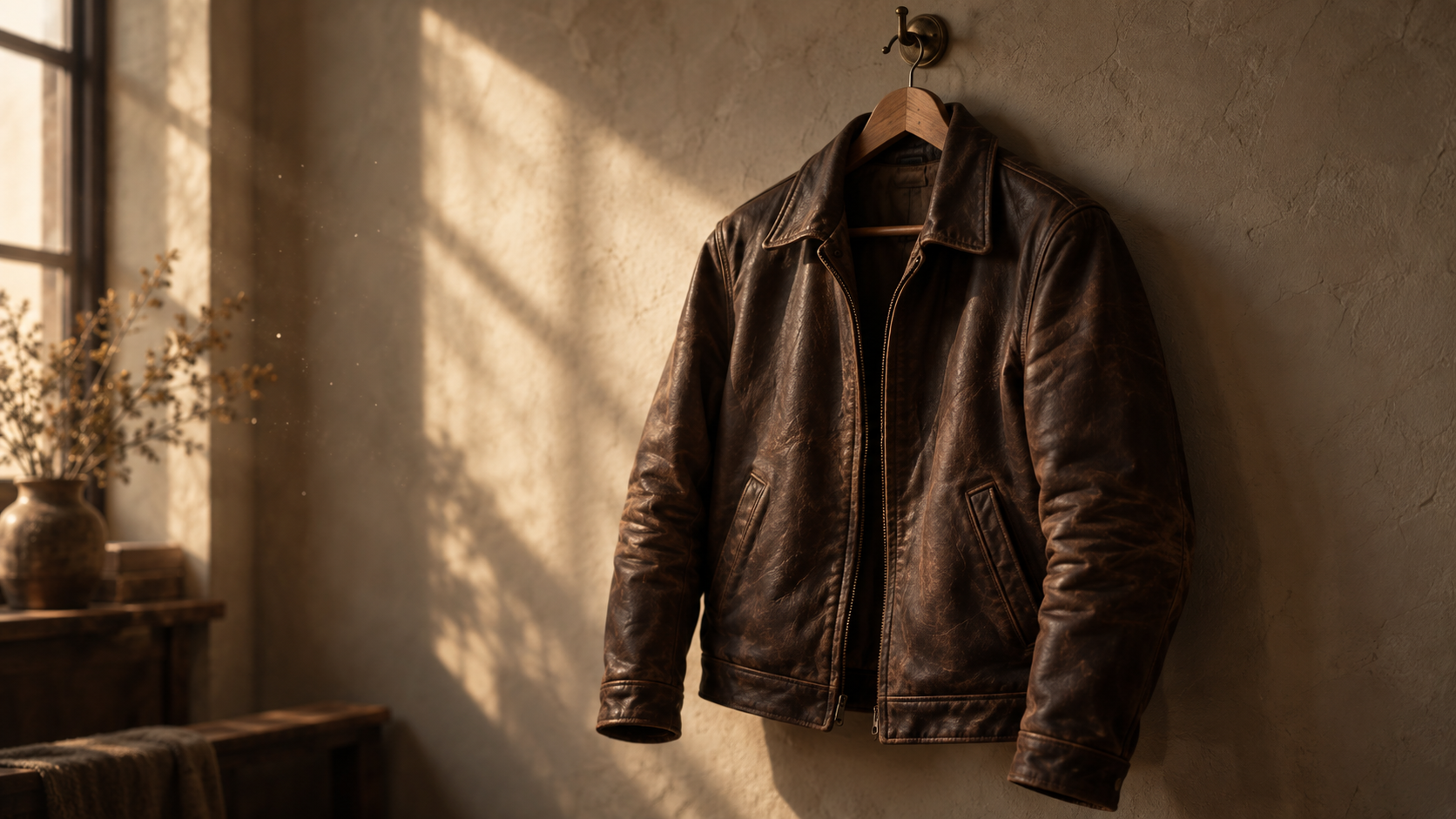
New and unworn. The surface is smooth and evenly colored with no crazing. The stiffness is concentrated at shoulders, elbows and collar. It creaks rather than crackles, and conditioner beads on the surface instead of soaking in. A good tell: waxy and oily hides stiffen noticeably in the cold, so a jacket that is much stiffer in a cold hallway and loosens after twenty minutes of wear is almost certainly this.
Dried out. The leather looks dull and thirsty. Put a drop of water on a hidden seam allowance and it darkens and stays darker. Flex a panel and the grain shows fine crazing rather than a smooth fold. Most tellingly, it is stiff all over, including low-flex areas like the back panel that body movement would have kept supple if the leather were merely unworn.
Water damaged. This one is patchy and irregular, which is the key difference. Look for tide lines, blotchy color, panels that dried into a distorted shape, and a board-hard patch next to a normal one. Stiffness concentrates where water pooled, at shoulders, cuffs and hem, and is worst wherever the jacket sat near heat while wet.
Why leather stiffens at all
Worth understanding, because it explains every piece of advice below.
During tanning, hides are fatliquored: oils are worked in as an emulsion, amounting to only three to ten per cent of the leather's weight. Without them, leather dries into what the trade literature bluntly calls a hard, horny mass with no practical value.
Those oils do two jobs. The fats plump the fibers so they do not collapse together. The oils lubricate so the fibers glide over one another as the water leaves. Take them away and the collagen fibers shrink, come together, and bond to each other through ordinary molecular attraction. That is what stiffness physically is.
Too much of it is also a known defect, not a bonus. Over-fatliquored leather goes excessively soft and raggy. This is the scientific basis for every warning below about over-oiling a jacket: you would be reproducing a tannery fault at home.
What wearing it actually does
This is the most useful fact in the whole subject and it deserves to be the centerpiece.
Tanneries soften leather mechanically, by staking, which is flexing the hide to break the bonds formed during drying, and by milling, which is tumbling hides in drums for hours. Two identical hides can end up with completely different handle based on mechanical softening alone.
Wearing a jacket is staking, performed slowly, by your own body. Every flex of an elbow breaks those inter-fiber adhesions and frees the fibers to slide. Body heat helps by softening the waxes already in the hide.
Which is why the most credible advice on this subject comes from makers who sell no conditioner at all. Aero Leather tell customers to wear it and not to mollycoddle it, and that a new jacket of theirs does not require much care for the first several years. A maker telling you not to buy product is the most trustworthy thing in this entire field, and we would rather repeat it than sell against it.
Realistically: one to two weeks for the flex points to relax, about a month before it is noticeably more comfortable, three to six months before it has conformed to you. Frequency beats elapsed time by a wide margin. Daily wear gets you in three weeks roughly where weekly wear takes six months.
Conditioning a dried-out jacket
The mistake here is dose, not product.
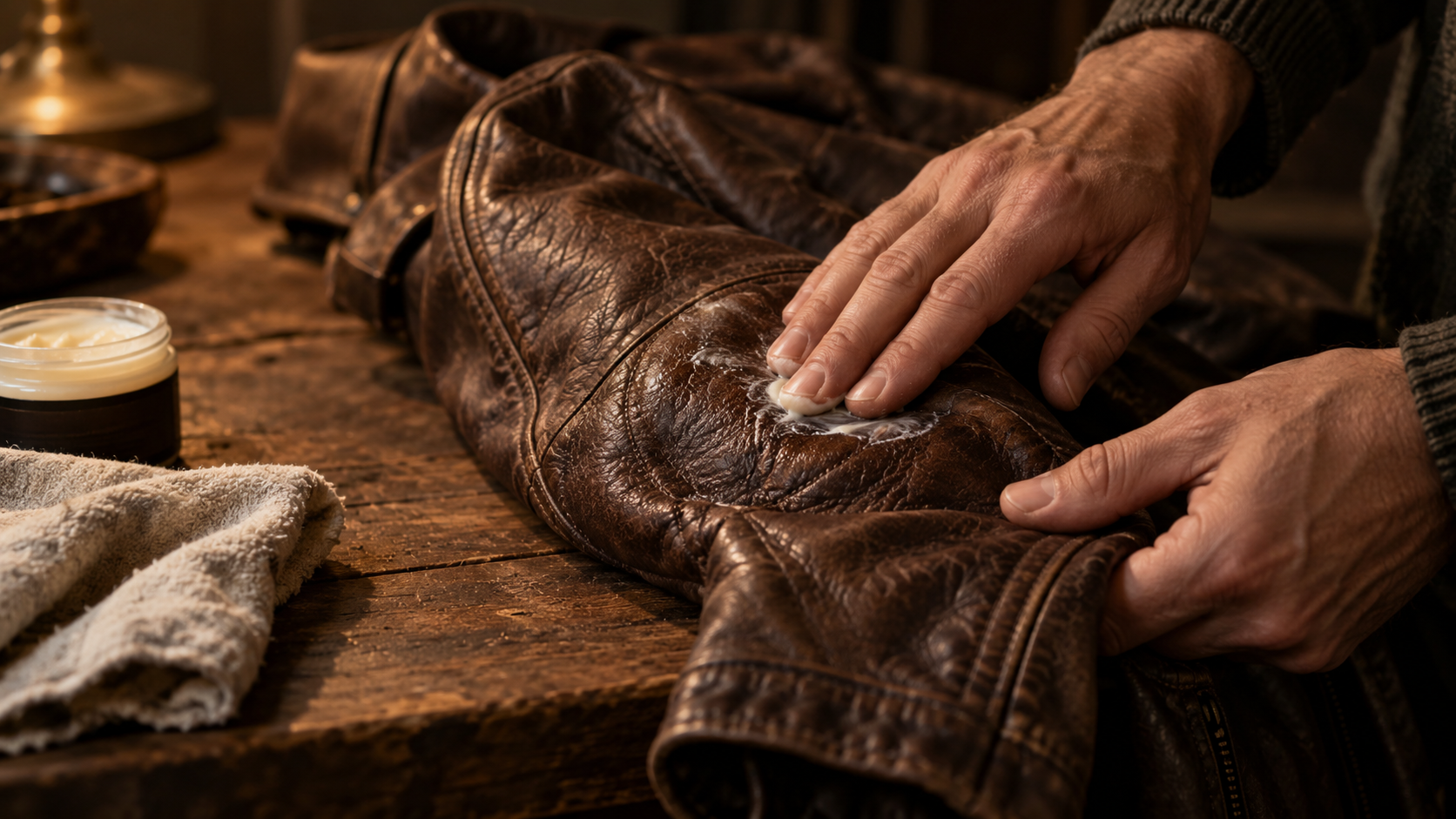
Spot test first, on a hidden area, and let it dry completely. Expect temporary darkening that fades.
Then work panel by panel: back, each front, each sleeve, collar. Dryness is rarely uniform, and sleeves and shoulders are usually thirstiest. Apply thin and even with a lint-free cloth, and then flex each panel by hand while the fibers are lubricated. That combines the chemical and the mechanical route, which is the actual answer here.
Wait twenty-four hours. Wipe off whatever did not absorb. Only then consider a second coat.
Three coats over three months, not three coats in an afternoon. Less is more, and frequent light applications beat occasional heavy ones. Our Leather Jacket Conditioning Lotion is formulated for garment-weight leather, which is the distinction that matters most and which we come back to below.
Be realistic about the result. Experienced collectors who restore vintage jackets are consistent on this point: leather that has gone genuinely hard is damaged, and you can mitigate that damage but you cannot undo it. Conditioning restores the leather's ability to soften. Wearing it does the softening.
What wrecks garment leather
Heat guns, hair dryers and tumble dryers. Thoroughly wet leather shrinks somewhere between 75 and 85°C, and aged leather shrinks lower than that because its heat tolerance falls as it deteriorates. A tumble dryer on high runs around 60°C, commercial units to 80°C. A heat gun runs from 100°C to 550°C. Every one of these is a way to shrink a jacket, not soften it.
Olive oil and other kitchen oils. Leather is permeable and soaks up any excess oil, which then sits invisibly in the back layers and resurfaces over time as spreading spots. It cannot be removed with any cleaner available to the public, and even professional deep cleaning rarely gets it all.
Rubbing alcohol, and anything containing it. Window cleaner, hairspray, disinfectant wipes. Alcohol is a solvent: it strips the finish, lifts dye causing blotching, and removes the residual oils, leaving the leather drier and stiffer than before.
Saddle soap. The category spans pH-neutral products to genuinely caustic ones above pH 10, and you cannot tell which you have from the tin. Alkaline soap on leather, which is naturally acidic, hardens and darkens it and leaves crusty residue in the grain. It was formulated for thick saddle leather, which is a different material from a jacket.
Mink oil and neatsfoot oil. These are boot products, and the distinction matters. On a jacket they darken heavily, over-soften so the leather stretches and loses shape, and leave residue that transfers onto your clothing.
Neatsfoot in particular is genuinely contested rather than settled. Some saddle makers recommend pure neatsfoot in thin coats on heavy horsehide and get good results. Against that, neatsfoot compound is cut with petroleum oils that can accelerate decay of natural stitching, and there is a real argument that heavily oiled leather becomes dependent on it. Our position: pure neatsfoot on heavy horsehide, sparingly, is defensible. Neatsfoot compound on thin garment leather is not.
The washing machine. The honest reason is not that it always destroys a jacket. Vintage collectors do it deliberately to shrink oversized pieces. It is that the outcome is unpredictable and irreversible, the lining and the zipper tape are damaged independently of the leather, and air-dried results come out stiff, which is the problem you were trying to solve.
Why boot rules do not transfer
Lightweight garment leather runs around 0.5 to 0.9 mm. Mid-weight jacket leather runs to perhaps 1.6 mm. Footwear leather starts at 2.0 mm and belts and soles run to 3.5 mm.
A jacket hide is often two to four times thinner than boot upper leather. A dose of oil a boot absorbs into its depth will saturate a jacket panel front to back.
Beyond thickness, a boot is a structure. It has to hold shape, resist water and support a foot, and stiffness is a feature. A jacket is a textile. It has to drape and move. Every boot product is optimized to add body and protection, and applied to a jacket those exact properties are the defect.
Boot leather gets fed until it stops drinking. Jacket leather gets the smallest dose that restores flexibility. That is the whole distinction.
Suede and nubuck jackets
Almost everything above inverts, because suede has no finish layer and its entire surface is exposed nap.
Never use leather cream, conditioner, oil or wax on a suede jacket. With no finish to sit on, the product soaks into the fibers, mats the nap permanently and darkens it irreversibly. Our conditioning lotion is the wrong product for a suede jacket and we would rather say so than sell you one.
Brush first, always, with soft nylon on a garment rather than the brass you would use on boots, in one direction with the grain. On a merely matted jacket, that may be the entire fix. Gentle steam from at least six inches away, never lingering, then brush immediately while the fibers are warm. A dedicated suede conditioner spray if it genuinely needs one. Use our Suede & Nubuck Cleaning Kit rather than anything intended for smooth leather.
The closet smell
A jacket that comes out of summer storage musty has usually come out stiff too, because the same still air and humidity swings caused both.
The cause is specific: body oils and perspiration absorbed during the wearing season are what mold feeds on, and a plastic garment bag traps moisture against the leather and creates a greenhouse. Dry-cleaner bags are for transport only.
Air it out first, on a padded hanger, unzipped, somewhere shaded and well ventilated, for two to three days. That fixes most cases at no cost and no risk. If it persists, activated charcoal in a breathable pouch alongside the jacket for two or three days. Baking soda on the lining only, never on the leather. Dilute white vinegar misted on the lining as a last resort.
Never bleach or ammonia, and never hang it in direct sun to air out, which fades the color and dries the surface. Store it on a wide contoured wooden hanger in breathable cotton, somewhere with air movement, and clean it before you put it away rather than after you take it out.
Frequently asked questions
Should I condition a brand-new leather jacket?
Usually not. A new jacket has plenty of oil in it. It is stiff because the fibers have not been worked loose yet, and only wearing it does that.
How long does it take to break in a leather jacket?
One to two weeks for the flex points, about a month to feel comfortable, three to six months to conform to you. Wear it daily and you will get there roughly five times faster than wearing it weekly.
How much conditioner should I actually use?
A dime-sized amount for the whole jacket. That is far less than most people expect, and using more is the most common way people ruin garment leather.
Can I put my leather jacket in the dryer to soften it?
No. A dryer on high sits inside the shrink range for aged leather, and the result you get is a smaller, stiffer jacket.
Is mink oil good for a leather jacket?
It is a boot product. On a jacket it darkens heavily, over-softens so the leather loses shape, and transfers grease onto your clothes.
My jacket got soaked in the rain. What now?
Wide padded hanger, room temperature, good airflow, away from radiators and sun. Twenty-four to forty-eight hours. Then a thin coat of conditioner, because the water took oils with it.
Conclusion
The reason this subject is so confused is that people apply the dried-out answer to a new jacket and the new-jacket answer to a dried-out one. Spend two minutes on the diagnosis and the rest is straightforward.
If it is new, wear it, and resist the urge to help. If it is dried out, thin coats a day apart over months, flexing each panel as you go. If it got wet, dry it slowly and properly first. And in all three cases, remember that the softening is done by movement. Conditioner restores the leather's ability to respond to being worn. It does not do the work for you.
Recommended products
- Eagle Leather Jacket Conditioning Lotion — formulated for garment-weight leather
- Eagle Suede & Nubuck Cleaning Kit — for suede and nubuck jackets
- Eagle Leather Oil Conditioner — for heavier hides that genuinely need feeding
- Eagle Exotic Leather Cleaner & Conditioner Spray — for reptile and exotic trim
Related reading: 7 Things People Put on Leather That Ruin It and Mink Oil vs. Leather Conditioner vs. Saddle Soap.
