
How to Get Scuffs Off Patent Leather Shoes (Without Ruining the Shine)

Search for how to get scuffs off patent leather and you will be told to use acetone, toothpaste, baking soda and a Magic Eraser. Those four pieces of advice appear on some of the highest-traffic pages on the internet, including one from a major hardware retailer.
All four damage patent leather. Not immediately, in some cases, which is exactly why the advice survives.
The reason so much of this is wrong comes down to a single fact that most of those pages never mention: on a patent shoe, the shine is not the leather. It is a thin polymer film sitting on top of the leather. Once you understand that, the right answer and the wrong answers separate themselves.
The short version
- Patent leather is a polyurethane and acrylic film over a leather base. You clean the film. You cannot condition it, and you cannot polish it with wax.
- Most marks are transfer: rubber or pigment sitting on top of an intact film. Those come off.
- A cut through the film does not come off. It can only be concealed.
- Three tests tell you which one you have in about ten seconds.
- Mineral oil and petroleum jelly are chemically among the safest things you can put on it. Acetone is among the worst.
- White creases are not dirt. They are microscopic voids inside the film, and they will not wipe away.
Work out what you are looking at first
This is the step every competing article skips, and it is the one that saves shoes. Half the people reading this are about to try to remove damage that cannot be removed, and will make it worse trying.
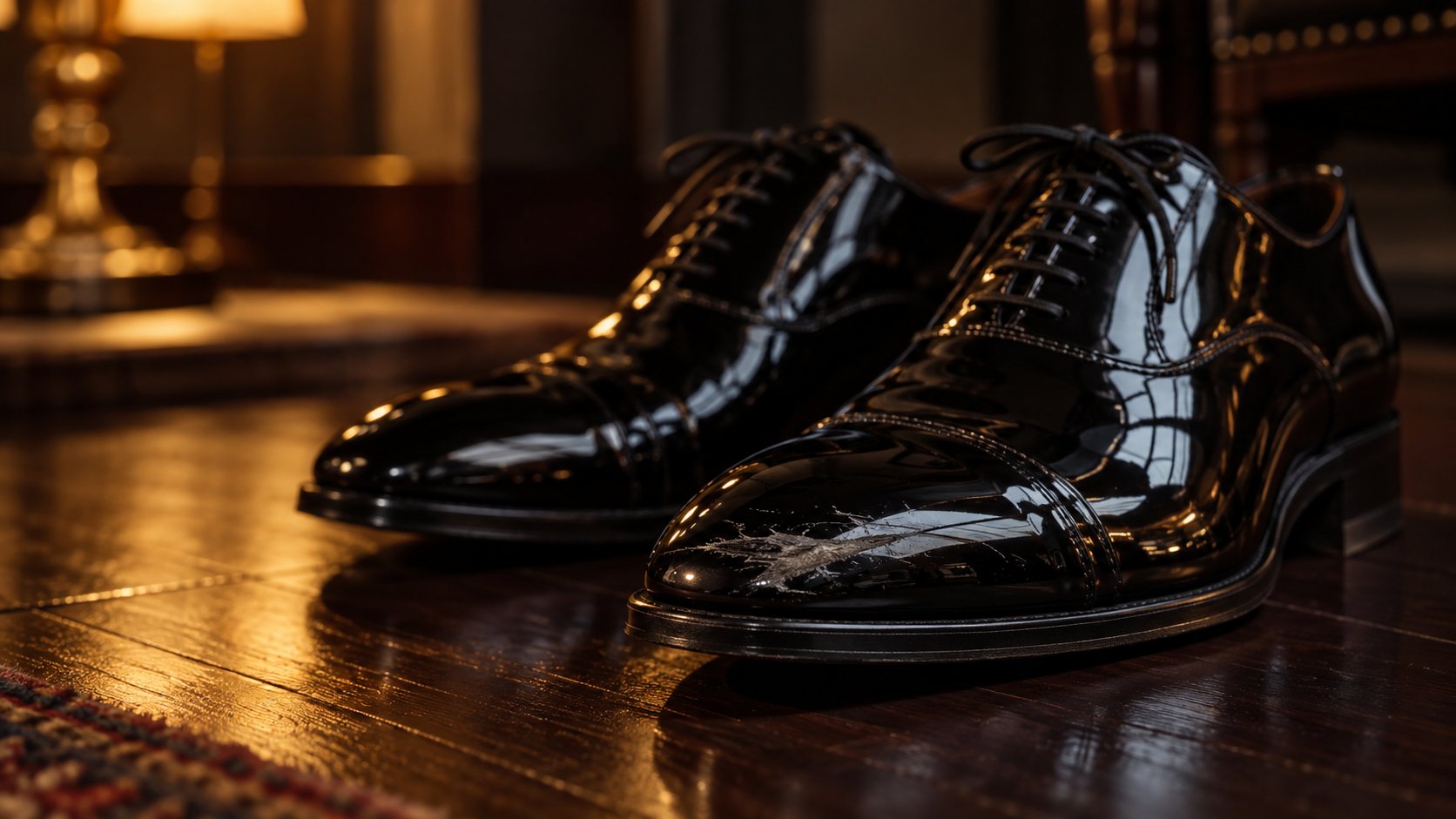
The wipe test. Dust the shoe off and wipe the mark with a dry cloth. If it lightens at all, even slightly, you are dealing with transfer sitting on the surface. That is good news.
The fingernail test. Run a fingernail lightly across the mark. If it glides over with nothing to catch on, the film is intact. If your nail drops into a groove, the film has been cut.
The raking light test. Tilt the shoe under a lamp and watch the reflection. Transfer reads as a smear that moves with the reflection. A cut reads as a line that breaks the reflection, interrupting the mirror image along its length.
One more useful tell: on black patent, a white or gray line usually is not a mark at all. It is the film itself deforming, which we come to below.
What works on transfer scuffs
Start gentle and escalate only if you need to.
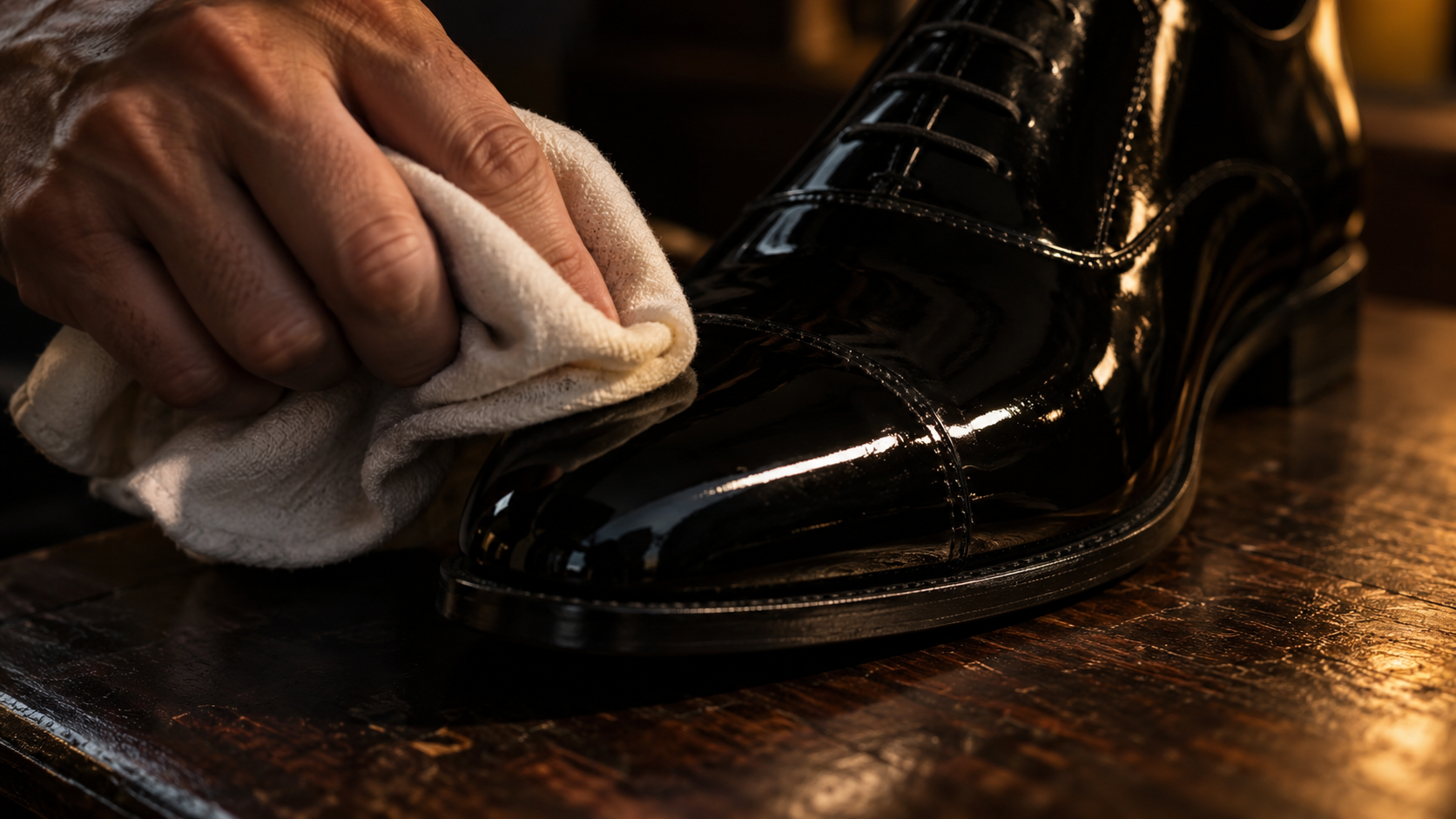
Mild soap and water. Genuinely the correct first move, and it costs nothing to try because the film is waterproof. A drop of mild soap in warm water on a soft cloth, gentle circles, wipe with a clean damp cloth, dry thoroughly. A surprising proportion of what people think is damage turns out to be residue.
A dedicated patent leather cleaner. This is what the category exists for. It cleans without abrading and leaves a thin protective layer, and pigmented versions will tint into a shallow scratch and blend it with the surround. Our Patent Leather Cleaner Kit is built for this. Apply on a slightly damp cloth, give it a few minutes, then buff with a clean dry cloth.
Petroleum jelly or mineral oil. Worth understanding why these work, because nobody explains it. They do two things. They soften and lift rubber transfer so it wipes away instead of being scrubbed away. And they optically fill micro-abrasions: a scuffed patch scatters light because it is rough, and a film of oil with a similar refractive index fills that roughness and restores the reflection.
That second mechanism is also the catch. If the mark reappears after you wipe the oil away, you concealed it rather than removed it. And any residue left behind is tacky and collects grit, which is what causes the next scuff. Buff it off completely.
A white vinyl eraser, lightly, on a stubborn transfer mark. Note the word white. Pink erasers contain pumice and will mar the surface.
Why acetone is the worst thing on the list
Polyurethane chemical resistance data makes this unusually clear. Measured after prolonged contact, water and mineral oil cause essentially no swelling in polyurethane. Isopropyl alcohol causes around sixteen per cent. Acetone causes roughly a hundred and five per cent, with a corresponding collapse in strength.
That is a laboratory figure on a related material rather than a patent topcoat specifically, and a cured coating is somewhat tougher. But the ranking holds, and it explains exactly why the traditional remedies are the traditional remedies.
There is a second effect that matters more, and it is the reason "it worked fine for me" reviews are unreliable. Solvents can cause environmental stress cracking: the solvent diffuses into the polymer, swells it, and lowers the stress at which it will craze. The film then fails later, under normal flexing, at a fraction of the load it used to tolerate.
In practical terms, you wipe acetone on a shoe, it looks fine, you wear it twice, and then it crazes at the vamp. Because the damage showed up days later, nobody connects it to the solvent.
What never to use
Magic Eraser. Melamine foam cleans by acting as extremely fine sandpaper. The manufacturer's own material description warns it will scratch surfaces that are not sufficiently hard. A thin polymer topcoat is not sufficiently hard. You end up with a hazed patch larger than the scuff you started with, and it is permanent.
Toothpaste. It works on teeth because it is abrasive. You are wet-sanding a gloss coat.
Baking soda. A mild abrasive slurry with no solvent action at all, which means abrasion is the only way it can possibly work.
Shoe polish and wax. Nothing absorbs into a sealed film. It sits on top, traps grime and dries cloudy, and cream polish settles into every crease and makes creasing look worse.
Saddle soap. It cleans by lifting fats out of leather, and there are no accessible fats in a sealed film. What it does leave is a glycerin and wax bloom on a mirror surface that then has to be removed.
Heat. Patent softens and distorts, and aged film softens at lower temperatures than new film. Softening the film while it is under flex is precisely how you set a permanent deformation.
When the scratch has gone through
Be clear-eyed about this: you are concealing, not repairing. The film was flow-coated as a liquid across a whole hide and cured in a heated tunnel. That cannot be recreated on a finished shoe.
In order of how committal they are: petroleum jelly fills the groove and restores local reflectivity, which is temporary and perfect for an event in two hours. A pigmented patent cleaner tints into the scratch and blends it, which works far better on black than on any other color. Leather filler is not an option on shoes, because it cracks out at the first flex.
Take it to a specialist if the shoe is not black, if the film is peeling rather than cut, if the surface has gone tacky, or if the shoe is valuable enough that a bad amateur job would cost more than the repair.
Why the crease turns white
This one has a real explanation and almost nobody gives it.
When the film is bent repeatedly, crazes form inside it: a network of microscopic voids and fibrils. Those voids have a lower refractive index than the polymer around them, so light scatters at the boundaries and a normally clear material turns opaque. The white line is not pigment loss and it is not dirt. It is light bouncing off holes.
Which means it will not wipe off, and oil only hides it temporarily by filling the voids that reach the surface. It also means the white line is an early warning rather than a cosmetic annoyance, because crazes eventually coalesce into true cracks.
Fine flex lines are normal wear. Sharp whitening, brittle ridges, tackiness or visible splits are coating failure, and that is a repair question rather than a reason to apply more product. One thing worth knowing: patent that cracks within the first few wears is a defect, not wear. Return it.
Storage, which is most of the battle
Patent sticks to itself and to whatever it touches, because soft polymer films in sustained contact under pressure bond to each other, and because plasticisers migrate to the surface and act like a contact adhesive. Heat and humidity accelerate both.
Never store patent in plastic. A plastic bag left against a patent surface will leave hazy marks where it touched, and trapped moisture causes both mildew and the tackiness that means professional refinishing.
Light patent has a second problem: dye migrates into it from dark materials stored alongside. Once color transfer has gone under the gloss layer it is close to impossible to remove without stripping the coating. Because it is time and pressure dependent, wiping the shoe down after each wear usually solves it. Leaving it a month usually does not.
Store cool, dark and dry in a breathable white cotton bag, with shoe trees in within minutes of taking the shoes off, and separated so patent never touches patent. If you use acid-free tissue, use the unbuffered kind: buffered tissue is alkaline, and leather is a protein that does not want alkaline contact.
Frequently asked questions
Can you use a Magic Eraser on patent leather?
No. It is a micro-abrasive. It will lift the mark and dull the gloss permanently in the same stroke, over an area larger than the original scuff.
Will Vaseline remove scuff marks from patent leather?
Often, yes, and it is one of the safest things you can use. Work it in, leave it a few minutes, then buff it off completely so it does not stay tacky and collect grit.
Can you use nail polish remover on patent leather?
No. Acetone dissolves the coating, and the damage frequently appears days later rather than immediately, which is why people think it worked.
How do I get black scuff marks off white patent shoes?
Mild soap and water first, then a patent cleaner. If the black has gone under the gloss it is dye migration, not a scuff, and it will not come out.
Why did my patent leather crease turn white?
Microscopic voids inside the film scattering light. It is not dirt and it will not wipe off. Oil hides it temporarily.
Can you polish patent leather?
Not with wax. You restore the shine with friction on a chamois or soft cloth, plus a dedicated patent cleaner. Wax polish just goes cloudy.
Conclusion
The single most useful thing you can do with a scuffed patent shoe is spend ten seconds working out whether the mark is on the film or through it, because the two problems have completely different answers and only one of them has a fix.
If it is transfer, soap and water or a patent cleaner will almost always handle it. If it is a cut, accept that you are concealing it and choose your method accordingly. And whatever the mark, keep the abrasives and the solvents away from it. A dull patch is permanent in a way that a scuff never was.
Recommended products
- Eagle Patent Leather Cleaner Kit — cleans and protects without abrading
- Eagle Leather Conditioning Lotion — for the unfinished leather parts of a patent shoe
- Eagle Shoe Cream Polish Kit — for smooth leather shoes, not patent
- Eagle White Shoe Protector Spray — for light-colored shoes prone to transfer
Related reading: 7 Things People Put on Leather That Ruin It.
