
Can You Use Mink Oil on Suede? How to Fix It If You Already Did

If you are reading this, there is a decent chance you have already done it. You had a tin of mink oil, you had a pair of suede boots that were getting scuffed, and the connection seemed obvious.
Every other page on this question answers whether you should. Almost none of them answer the question you actually have, which is what to do now. So we will get the verdict out of the way quickly and spend the rest of this on the rescue.
The short answer is no, mink oil does not belong on fashion suede or nubuck. The longer answer is that how much you can recover depends almost entirely on how much you used, how long ago, and what color the suede is.
The short version
- Mink oil coats the nap fibers and glues them flat. The leather is fine. The surface is the casualty.
- It darkens suede, usually permanently. Claims that the color comes back as the oil oxidizes are wrong.
- Dry absorbents are the workhorse of the rescue. Expect three to six passes, not one.
- No heat, no water on a patch, no dish soap. Each of those turns a recoverable problem into a permanent one.
- Roughout work boots are a genuine exception. Roughout is not suede.
- Light-colored suede is the hardest case. Once it goes dark it does not come back.
Why suede reacts the way it does
Smooth leather has a dense grain surface with a finish sitting on top of it, which is why you can apply a conditioner and then wipe the excess off. Suede has no closed surface at all. It is thousands of individual collagen fiber ends standing proud of the hide, and those fibers are the entire product.
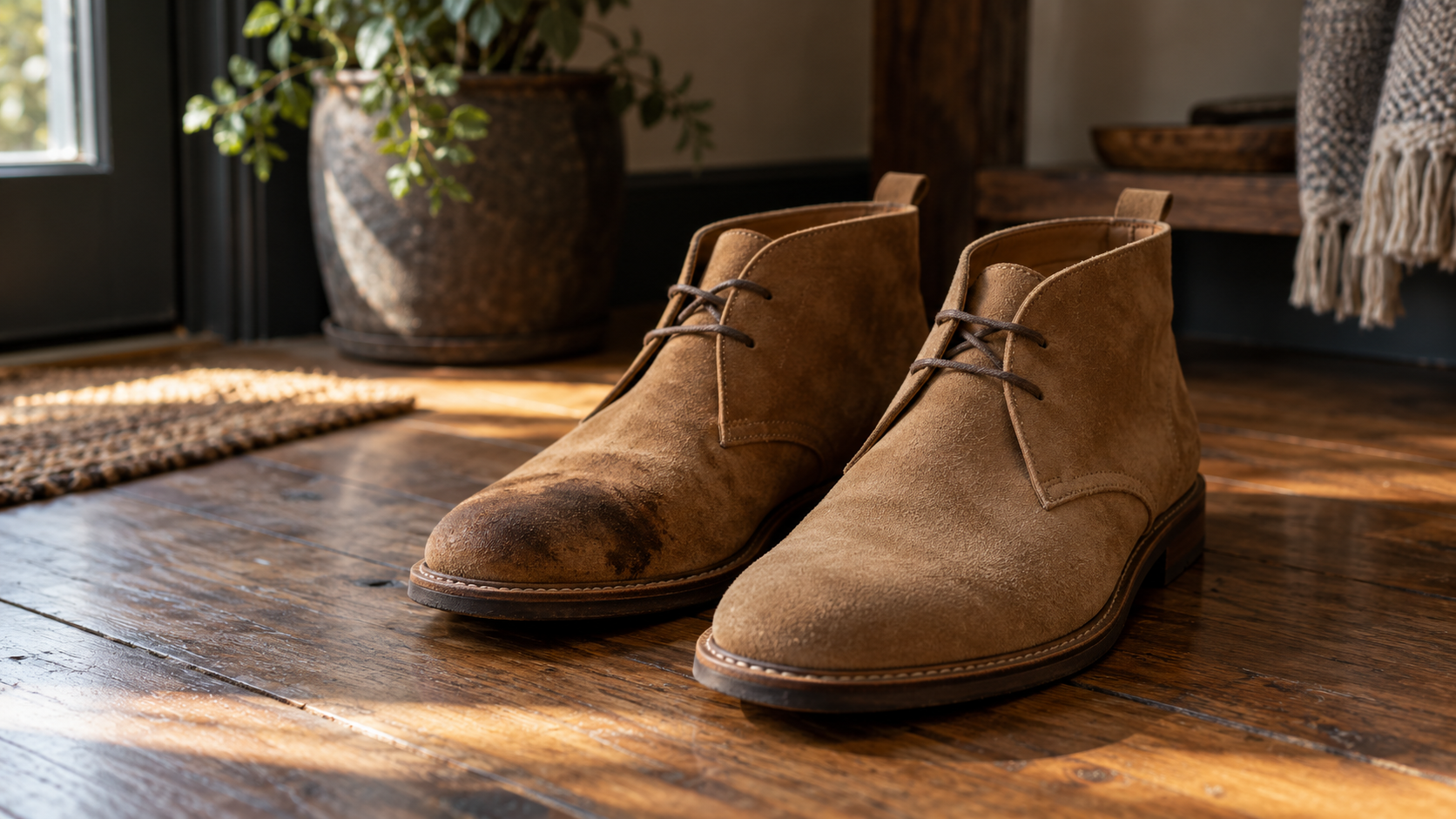
The velvet look is an optical effect. Upright, separated fibers scatter light diffusely. That scatter is what you see as the nap, and it is why brushing one way looks light and the other way looks dark.
Mink oil is a heavy, tacky fat. It coats each fiber, makes them adhere to one another, and lays them flat. Less scatter means the surface reads as darker, slicker and patchy. There is nothing to wipe the oil off, because there is no surface for it to sit on. It is inside the fiber bundles, and it keeps wicking outward by capillary action for days after you applied it.
Worth knowing: much of what is sold as mink oil contains only a fraction of actual mink fat, cut with rendered pig fat and often silicone. The silicone is its own problem, because it clogs the pores and stops the leather breathing.
The good news, such as it is, is that the hide itself is usually undamaged. It is still leather, still strong. What you have is cosmetic damage to the surface, which is a better position than it feels like.
The exception that confuses everyone
You have probably seen bootmakers recommend oiling roughout boots, and wondered why that is fine when this is not.
Roughout is not suede. It is full-grain leather worn flesh side out, with the dense grain layer intact and simply facing inward. The nap is the grain-corium junction rather than a corium split, which makes it far tougher and naturally more water-shedding. Some roughout is oil-tanned and stuffed with oils from the outset.
The useful distinction is not whether it is napped. It is whether the nap is decorative or whether it is armor. On a work boot, the nap is incidental to a leather chosen for toughness, the boot is meant to look beaten, and darkening reads as patina. On a desert boot, a Chelsea, a sneaker or a jacket, the nap is the product, and matting it is the same as ruining it.
The rescue sequence
Work least aggressive first and stop at the step that works. Do all of this on a fully dry item, in good light, and test in a hidden spot.
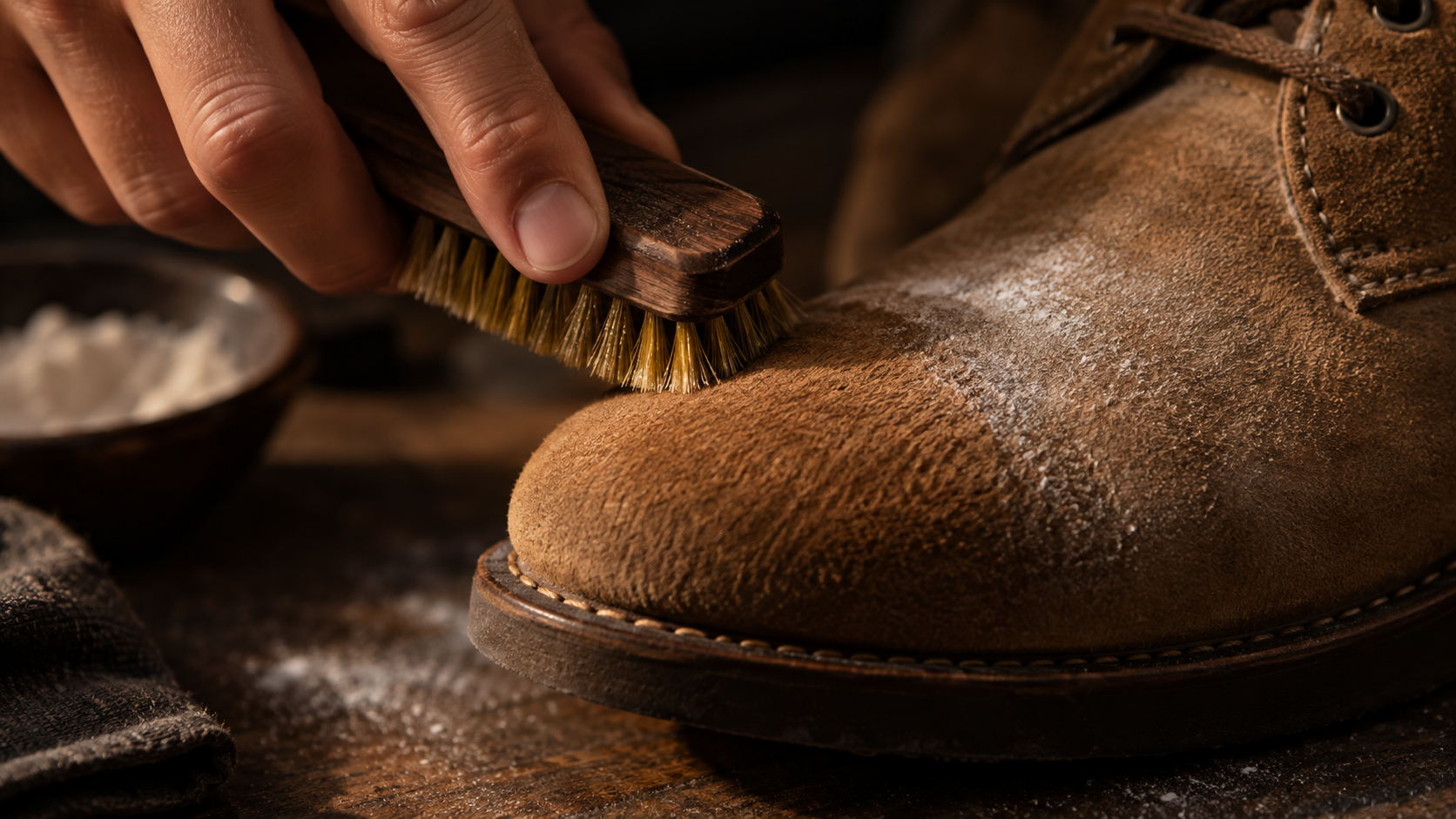
Step 1: Blot, if it is still wet. Straight down with a clean cloth. Never rub, never circles. Rubbing drives the oil deeper and spreads it sideways. If you applied a paste and it is still sitting on the surface, get the surplus off now rather than letting it absorb.
Step 2: Dry absorbents. This is the workhorse, and it works by pulling oil out through capillary action without introducing any moisture.
Fuller's earth is the professional choice. Cornstarch is the household one and works well. Talc is finer and gets deeper into the nap. Skip baking soda if you have an alternative, because it is alkaline and leather wants acidic.
Apply a generous layer, dab it gently with a finger to help it penetrate, and leave it twelve to twenty-four hours. Brush it away with the nap, then vacuum with the nozzle held slightly above the surface rather than pressed into it.
Then do it again. And again. A deliberate application of mink oil takes three to six passes minimum. A light spray caught quickly might clear in two or three. When a fresh charge of powder comes off still white and the shade has not moved, absorbents have given you everything they will.
Step 3: Eraser and brush. Once the bulk oil is out, attack the matting. A suede eraser on the flattened, shiny patches, then brush the crumbs away or you will just redistribute them. Be honest about what the eraser is doing: it will not remove oil. Its job here is to abrade the burnished top layer of fiber so brushing can get underneath, and to lift the dirt the oil has been collecting.
Step 4: A dedicated degreaser. When absorbents plateau, solvent chemistry dissolves the oil so it can be blotted out. The technique detail here matters more than the product: dab from the edges inward, never center-outward, and use a fresh section of cloth every single time. A solvent liquefies the oil, so a loaded cloth or an outward motion gives you a wider, ringed stain than you started with.
Step 5: Raise the nap. Brass brush to break up and separate the fibers, with many light passes rather than a few heavy ones. Then a crepe or soft bristle brush to finish and set the nap in one direction. Our Suede & Nubuck Cleaning Kit has the brushes and eraser for this.
Expect this to be the slow part. Experiment with brush angles, and accept that it takes longer than you want.
What not to do
No heat. No hair dryer, heat gun, radiator or sun-baking. Heat permanently alters the fiber structure, and it thins the oil so it migrates deeper and wider before re-solidifying. You turn a patch into a saturation. The hot-iron and brown-paper trick that lifts candle wax does not apply here, because mink oil is a liquid-phase fat, not a wax that resolidifies into a liftable crust.
No water on a patch. Water flattens the nap, and as it evaporates it pulls the hide's own oils toward the edges of the wet area, leaving permanent tide marks. A controlled full shampoo of the entire item is fine and normal. Wetting one spot is not.
No dish soap or detergent. Dish soap pushes oil deeper while leaving water rings, and surfactants emulsify the oil so it travels with the water rather than leaving the material.
No rubbing alcohol or hand sanitiser. Both strip the surrounding dye and leave a bleached pale patch that is more visible than the oil was.
No aggressive scrubbing, and no wire brush. Friction compresses fibers into shiny matted patches and burnishes the oil into the surface. A steel wire brush is a roughout tool. On thin split suede it tears fibers out, and where fibers are gone they are gone.
No oiling the whole thing to even it out. The instinct is understandable and it trades a local problem for a global one.
How much you can realistically expect back
Nobody publishes recovery rates for this, and any article giving you a percentage invented it. What the evidence does support is a tiered forecast.
Good odds. A light spray, caught within hours, on mid to dark suede. Absorbent passes and thorough brushing get you close. Some darkening will remain.
Expect improvement, not invisibility. One coat of paste, caught within a day or two. Repeated absorbents plus a solvent spotter plus brushing typically leaves an area noticeably lighter than it is now but still darker than it was, with the nap partly restored. Uniformity is the enemy here, which is why some people end up treating the whole item to even it out.
Cosmetic damage. Several coats, or weeks of curing, or light-colored suede. Oxidized oil becomes a greasy residue that is difficult to remove at all, and once light suede darkens it does not come back. Plan around it.
Gone. Heat was applied. It was soaked and dried stiff. It was scrubbed with a wire brush. Nubuck is also harder than suede here, because its very short nap has less fiber length to recover.
Even professionals set expectations carefully. The good ones commit to the best technologically achievable result rather than showroom new, and note that it is often impossible to refinish back to the exact original color.
Re-dyeing, if it comes to that
Two rules, and both are non-negotiable.
First, the oil has to come out before you dye. Dye locks in any dirt or oil on the surface, and skipping the cleaning gives you a permanent blotch in a new color. Suede dyes are water-based and rely on the fiber being absorbent; oil is hydrophobic and occupies that space, so the dye takes heavily in clean areas and lightly in oiled ones, reproducing your blotch exactly.
Second, you can go darker, not lighter. Lightening suede requires stripping and is not a home job. The professional dye ranges are black, browns and reds for exactly this reason. Which is the hard truth for anyone in this situation: the oil already darkened your suede, so your only remaining direction is darker still. A sand desert boot can become dark brown or black. It cannot become sand.
Apply in two to four thin coats with twenty-four hours to dry, aiming for a soft consistent haze of color rather than a wet, shiny finish. Over-application gives dark sticky patches that ruin the texture. And note that dye fixes color, not nap. If the nap is gone you get an evenly colored item with a dead surface.
What to use on suede instead
Start by dropping the premise. Suede mostly does not need conditioning. It has no grain surface to crack, so the cracking risk that justifies oiling smooth leather barely applies. What it actually needs is a clean nap, water repellency and stain resistance.
For cleaning: a suede eraser for dry marks, a dedicated suede shampoo diluted and rinsed for anything worse, and the right brush for the material. Brass for sturdy boots, soft nylon for delicate pieces and garments, crepe for finishing.
For protection: a spray-on protector applied six to twelve inches away in sweeping passes, left thirty to forty-five minutes to dry so it does not leave water rings, reapplied when water stops beading. Our Fabric Stain Protector Spray covers this. Avoid silicone-heavy sprays, which clog the pores and stop the leather breathing.
If the color has faded rather than been oiled, a pigmented suede renovator restores saturation without changing the shade, and Nubuck and Suede Dye is the option when it has gone further than that.
Frequently asked questions
I put mink oil on my suede boots. Did I ruin them?
Probably not structurally. The leather is almost certainly fine. What you have damaged is the nap, and how much comes back depends on quantity, elapsed time and color.
Will the dark color lighten back up on its own?
You will see some minor lightening as the oil oxidizes and dust loads in. You will not get the original color back. Pages claiming the darkening reverses over time are wrong, and every professional source contradicts them.
How long do I leave cornstarch on suede?
Twelve to twenty-four hours per pass, and plan on three to six passes. Short thirty-minute applications are why people conclude absorbents do not work.
Can I use a hair dryer to melt the oil out?
No. Heat permanently alters suede fibers, and warming the oil makes it migrate deeper and wider before it sets again.
Will dish soap get oil out of suede?
No. It pushes the oil deeper, leaves water rings, and strips the hide's protective oils on the way through.
Why do people put mink oil on roughout boots but not suede?
Roughout is full-grain leather worn flesh side out, with the grain layer intact. It is tougher, more water-shedding, and meant to look weathered. Fashion suede is often a thin split with nothing protecting it, and the nap is the entire point of the material.
Conclusion
The thing worth holding onto is that you have not destroyed a pair of boots. You have changed their surface, and the leather underneath is intact. That is a far better position than it looks like on the day you notice it.
Go slowly. Dry absorbents, repeatedly, are boring and they do most of the work. Resist every instinct to speed it up with heat, water or scrubbing, because each of those is what converts a cosmetic problem into a permanent one. And if you land in the bottom band, dyeing darker is a legitimate outcome rather than a defeat.
Recommended products
- Eagle Suede & Nubuck Cleaning Kit — eraser, brushes and cleaner for the rescue
- Eagle Nubuck and Suede Dye — when re-dyeing is the remaining option
- Eagle Fabric Stain Protector Spray — what to use instead of oil
- Eagle 4-in-1 Mink Oil Kit — excellent on smooth leather, where it belongs
Related reading: How to Restore Faded Suede Shoes at Home, Mink Oil vs. Leather Conditioner vs. Saddle Soap and How to Clean Suede Shoes Without Ruining Them.
